

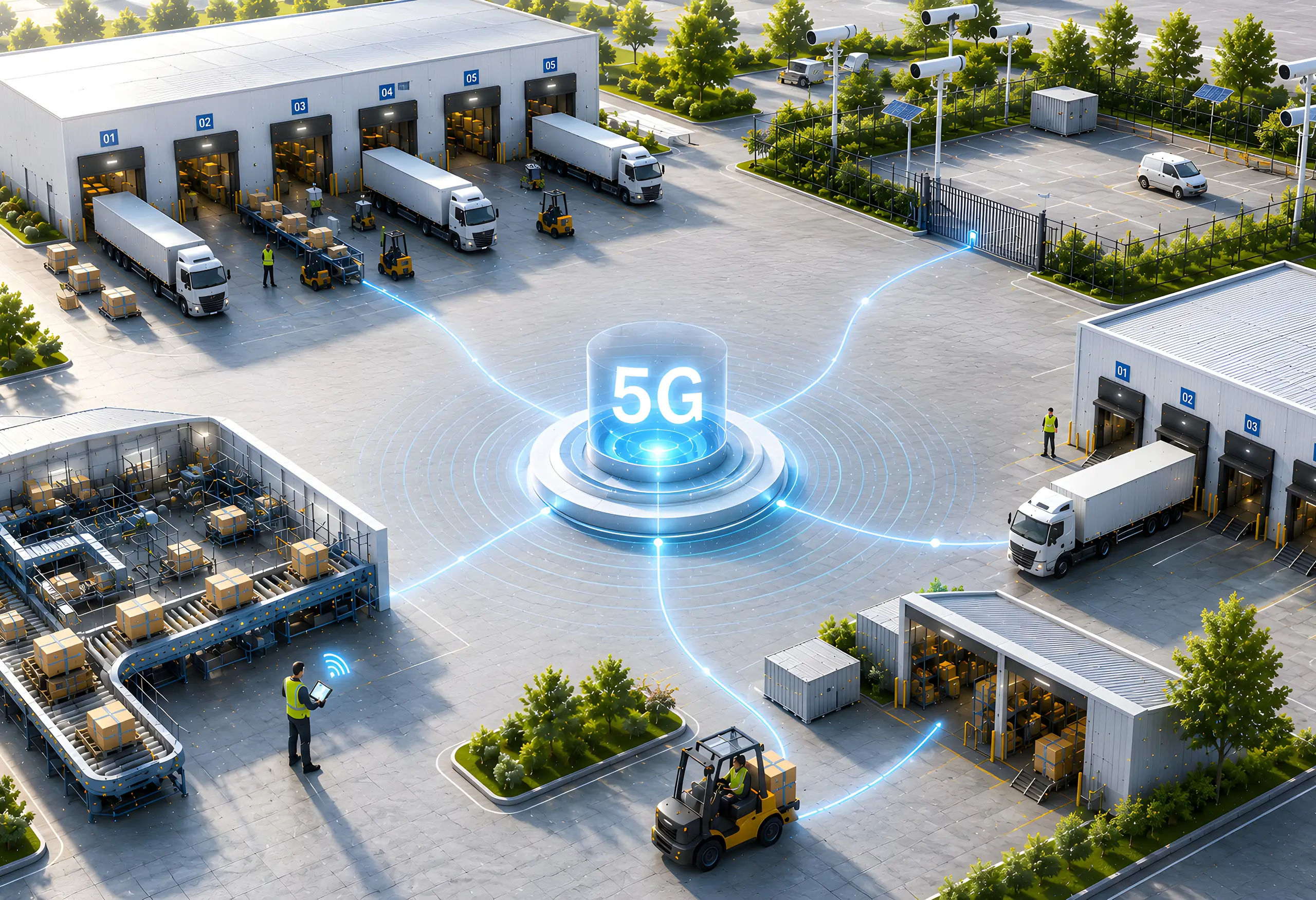
Most warehouse IT teams we talk to aren’t looking to rip out their Wi-Fi. They’re dealing with something more specific: a dock-door dead zone that won’t go away, scanner reliability that gets worse every time automation is added, or no clean answer for outdoor yard coverage. These aren’t Wi-Fi configuration problems. They’re structural limitations — and private 5G solves them differently. Here are the five situations where that difference is most visible.
By the numbers — why operational connectivity matters
$260,000/hour
11%
6%+
2 in 3
1. Cross-dock operations
Miss a beat and you've broken a delivery SLA.
Cross-dock facilities are built around constant movement. Workers and forklifts cycle between dozens of dock doors throughout a shift. As handheld scanners move across coverage areas, connectivity interruptions, roaming delays, or retransmissions can slow workflows and create opportunities for missed scans or delayed updates.
Research on cross-dock supply networks shows that well-executed cross-docking can reduce logistics costs by more than 6%. But those gains depend on accurate, real-time visibility into inventory and shipment status. Connectivity issues can undermine the operational efficiency that cross-docking is designed to deliver.
Highway 9’s Mobile Cloud manages device mobility at the cellular network level, enabling seamless handoffs as workers move throughout the facility. Devices remain connected while moving between dock doors, helping operations maintain real-time visibility without relying on Wi-Fi roaming performance.
2. Video surveillance — from dock cameras to yard perimeters
Warehouse security teams need continuous video coverage across dock doors, receiving bays, yard perimeters, and trailer rows. The challenge is that these environments have very different connectivity requirements.
Indoor cameras near conveyor lines or dense metal racking can operate in areas where Wi-Fi coverage is challenged by obstruction, reflection, congestion, or RF interference, making sustained HD video performance more difficult to guarantee. Outdoor cameras covering staging areas, parking lots, and trailer rows often require additional network infrastructure, such as outdoor access points, dedicated backhaul links, or extensive cabling.
Highway 9’s private cellular network can extend connectivity from the warehouse floor to the yard perimeter through a single managed network. The same infrastructure supporting operational devices can also connect surveillance cameras across indoor and outdoor environments, reducing network complexity and simplifying management.
For facilities running AI-based video analytics—such as object detection, intrusion alerts, or behavioral monitoring—a reliable, low-latency connection is often as important as raw bandwidth.
3. Loading docks — where indoor and outdoor connectivity collide
The loading dock is one of the most challenging wireless environments in a warehouse. It’s a transition zone where workers, forklifts, trailers, and inventory move continuously between indoor and outdoor spaces. Dock doors open and close throughout the day, while vehicles and equipment constantly alter the RF environment.
Many warehouses experience inconsistent scanner performance around dock doors, particularly where coverage must extend beyond the building envelope. While additional Wi-Fi access points and tuning can improve performance, coverage and roaming challenges can persist in these dynamic areas.
Loading docks are also among the highest-value connectivity points in the facility. They’re where inbound inventory is received, verified, and entered into operational systems. Delays, retries, or missed transactions at the dock can impact inventory accuracy and downstream fulfillment processes.
Highway 9’s private cellular network is designed to provide consistent coverage across indoor and outdoor operational areas. A properly designed deployment can extend connectivity from warehouse aisles to dock aprons, staging areas, and nearby yard locations, helping mobile workers and devices remain connected as they move throughout the facility. Enterprise-grade security, policy control, and device management are integrated into the same network architecture, reducing operational complexity.
4. Conveyor belt interference with handheld scanner connectivity
Modern conveyor systems rely on variable frequency drives (VFDs) and other industrial control equipment to regulate motor speed and automate material handling. These environments can be challenging for wireless networks due to a combination of electrical noise, metal infrastructure, moving machinery, and constantly changing RF conditions.
As conveyor density and automation increase, maintaining consistent wireless performance around active production areas can become more difficult. IT teams often respond with additional access points, channel optimization, and RF tuning, yet localized coverage and performance challenges may still remain.
Highway 9’s private cellular network operates in managed spectrum and uses cellular mobility mechanisms designed for industrial-scale device connectivity. Unlike traditional Wi-Fi deployments that depend on overlapping access point coverage and client roaming behavior, private cellular provides a more controlled connectivity environment for mobile scanners and industrial devices operating near conveyor systems.
Because the Mobile Cloud integrates directly with MDM platforms for eSIM provisioning, adding or replacing devices does not require reconfiguring Wi-Fi credentials or access point associations. Devices authenticate to the cellular network and can be centrally managed throughout their lifecycle.
5. Roaming between outdoor yards and indoor operations
Yard operations are among the most challenging mobility environments in logistics. Coverage must extend across loading areas, staging zones, trailer parking, and warehouse interiors, while workers, vehicles, and equipment move continuously between indoor and outdoor spaces.
Many facilities rely on separate indoor Wi-Fi and outdoor cellular networks. While effective in some scenarios, this approach introduces additional management complexity and requires devices to transition between different connectivity environments as they move throughout the site.
Public cellular networks can also create dependencies outside the organization’s control. The February 2024 AT&T outage highlighted how disruptions to carrier infrastructure can impact communications and connected services across multiple industries.
Highway 9’s private cellular network provides a single managed connectivity layer across both warehouse and yard environments. Devices remain connected as they move between indoor and outdoor operational areas, with centralized security, policy enforcement, and visibility. Asset tracking, scanning, and mobile workforce applications —including Zebra scanners, rugged Android handhelds, tablets, and other connected devices— can operate across the facility without requiring separate indoor and outdoor network architectures.
For organizations deploying a local private cellular core, critical operations can continue independently of public carrier outages, reducing reliance on external network infrastructure and improving operational resilience.
The common thread
All five challenges share a common theme: warehouse operations place very different demands on a network than a traditional office environment. Devices move continuously, coverage must extend across indoor and outdoor areas, and operational systems increasingly depend on real-time connectivity. As automation and throughput increase, network performance becomes more directly tied to operational efficiency.
A 2024 Siemens report found that unplanned downtime drains roughly 11% of annual revenues from the world’s 500 largest companies — a collective $1.4 trillion loss. The average cost per manufacturing facility is estimated at $260,000 per hour. While downtime has many causes, network reliability plays an increasingly important role in keeping industrial and logistics operations running smoothly.
The five challenges covered here—cross-dock mobility, video surveillance, loading dock coverage, conveyor-line connectivity, and seamless indoor-outdoor roaming—are all areas where private 5G can provide advantages over traditional Wi-Fi-only approaches.
Highway 9’s Mobile Cloud was built for environments where devices move, operations span indoor and outdoor zones, and reliable connectivity is critical to day-to-day execution. Rather than adapting office networking approaches to industrial environments, it provides a private cellular platform designed specifically for mobile, operationally critical workloads at the industrial edge.
Highway 9 Mobile Cloud — built for warehouse and distribution environments
- Cloud-native private 5G/LTE — no on-premises mobile core infrastructure to manage
- Unified indoor and outdoor coverage from a single private cellular network
- Integrates with existing firewalls, Azure AD (SSO), and MDM platforms for eSIM provisioning
- Application-aware QoS — prioritize e911, safety systems, and operational applications
- AI-ready — reliable low-latency connectivity for edge inference, autonomous equipment, and video analytics
- Single management console — manage indoor, outdoor, and multi-site deployments from one dashboard
- Named a Gartner Cool Vendor, recognizing innovation in private wireless networking
Highway 9 Networks builds the Mobile Cloud — a cloud-native private 5G/LTE platform that integrates with your existing Wi-Fi, security tools, and enterprise IT stack. Customers include MIT and leading manufacturers and distributors across the US.