

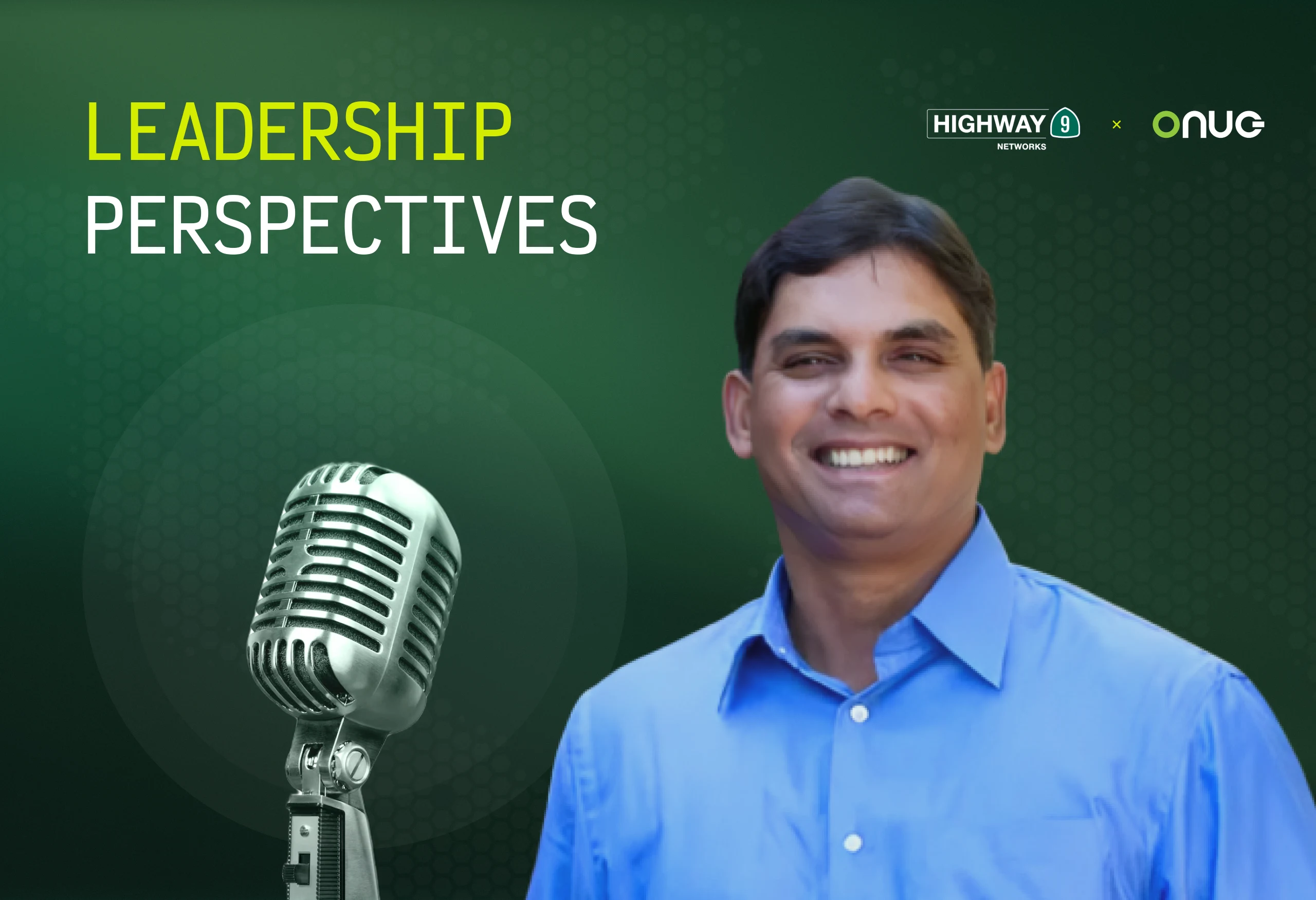
In a recent conversation on the ONUG Built for Trust Podcast, Highway 9 CEO Allwyn Sequeira sat down with host Nick Lippis to talk about where enterprise networking is heading — and why the shift to AI at the edge makes the underlying connectivity infrastructure more important, not less. What follows are the key ideas from that conversation, in Allwyn’s own words.
Listen to the full conversation
Allwyn Sequeira, CEO of Highway 9 Networks, in conversation with Nick Lippis on the ONUG Built for Trust Podcast — Episode 93.
The problem that started Highway 9
We did a marvellous job moving all the workloads into the public clouds. What remains on-prem are the users with their devices. How do we do for these users what we had done for the servers?
- Allwyn Sequeira, CEO, Highway 9 Networks
Why Wi-Fi breaks under real industrial workloads
The conversation gets specific quickly on why Wi-Fi isn’t the right answer for the environments Highway 9 is building for — auto manufacturing plants, AI data centers, hospital campuses, large distribution facilities.
In these environments, the devices aren’t humans with laptops. They’re autoguided vehicles, autonomous mobile robots, pick-and-place systems, conveyor-line scanners, and increasingly humanoid robots — all of which need high-fidelity, always-on, deterministic wireless connectivity.
Wi-Fi was all about best-effort, contention-based networking — operating in unlicensed, interference-prone spectrum with no determinism. It struggles with dense, real-time traffic.
- Allwyn Sequeira
He points to Tesla as a real-world proof point: their manufacturing plants moved to private 5G because the precision required on the assembly line simply couldn’t be delivered by Wi-Fi. The same pattern is repeating across auto manufacturing, hyperscaler data centers, and large enterprise campuses. At Mobile World Congress, every physical AI demo on the floor was running on private cellular — not Wi-Fi. The reason, in Allwyn’s words: “With Wi-Fi you can’t have your machines talk to you — even in small spaces.”
Three problems Highway 9 set out to solve simultaneously
Rather than treating private 5G as a standalone networking product, Highway 9 approached it as a three-layer architecture problem — the same holistic compute-storage-networking thinking that drove the best work at VMware:
- The wireless problem: Private cellular alone isn’t enough — because operations don’t stop at the building perimeter. Cars roll off an assembly line, get quality-checked outdoors, and receive software updates before leaving the lot. That’s an indoor-outdoor continuum. The answer is private cellular plus public cellular, with seamless handoffs across both.
- The IT/OT integration problem: OT devices — PLCs, Siemens controllers, Allen-Bradley systems, Honeywell equipment — are long-lived, slow to change, and managed by teams with very different rhythms from enterprise IT. Highway 9’s approach: don’t force forklift upgrades. Newer devices get native SIMs. Legacy OT devices connect via Modbus interfaces, Ethernet, or Wi-Fi gateways and backhaul over the cellular network. Same management umbrella, regardless of vintage.
- The orchestration problem: Edge inferencing hardware — Blackwells, Grace Hoppers — is expensive. As device sprawl grows, so does inferencing sprawl. Highway 9 built a layer that connects devices to their appropriate inferencing runtimes and manages the whole system, not just the access layer.
We call it the AI-native mobile cloud — or AI-native mobile infrastructure. The exact words will emerge as we proceed.
- Allwyn Sequeira
What agentic AI actually changed inside Highway 9
Agentic AI isn’t just a theme Highway 9 talks about — Allwyn describes it as what made their two most demanding deployments possible.
The first was MIT: an eight-story building, 50–60 radios, integrating three cellular operators. “It’s like playing whack-a-mole,” Allwyn says — change one configuration and something else breaks. The only way to converge frequency planning and configuration at that scale was with AI.
The second was a hyperscaler AI data center: hundreds of access points, managed as a complete service with separate fault domains to eliminate single points of failure. No humans on the floor — autonomous guided vehicles carry test and control equipment up and down the aisles. At that density and scale, human-in-the-loop management isn’t operationally viable.
Without agentic AI, I’m not sure we would have gotten as quickly to the end game of making this not just automated — but autonomous.
- Allwyn Sequeira
The architecture for network and security engineers
When Nick asks how engineers should think about this shift, Allwyn breaks it into three layers:
The access layer — treat private/public cellular as a third access tier sitting alongside your LAN and Wi-Fi. Don’t replace the existing backbone; extend it.
The integration layer — dovetail into existing IT infrastructure: DDI, DNS/DHCP/IPAM, MDM, NAC, Palo Alto, Zscaler, CrowdStrike. It should feel like an extension of what’s already there, not a separate telecom project.
The intelligence layer — an overlay that connects mobile devices and machines logically to the inferencing apps and edge runtimes they need, managed through a common service management plane.
The frame is one he used at VMware: logical zones on top of an IP leaf-and-spine backbone. It’s a natural progression for anyone who already thinks that way — not a rearchitecting exercise.
Where this goes — and the role of the 'autonomy officer'
On the question of whether humans eventually come out of the loop entirely, Allwyn draws on the IDS-versus-IPS debate from an earlier era of networking: detection to prevention. His view is that full autonomy is the direction, but removing humans entirely is premature and, in his words, almost irresponsible in the near term.
What he does predict — with conviction — is an explosion in device sprawl within two years. Humanoid robots and autonomous systems proliferating across industrial environments. Cheaper, more accessible inferencing at the edge. And a new organizational role to manage it all: what he calls an “autonomy officer” — someone who owns the convergence of IT, OT, and telco networks under a single control plane.
Campus AI, on-prem AI access — that will become a thing. It has to complement what’s already there. I expect to see that completely flourishing a couple of years from now.
- Allwyn Sequeira
Listen to the full conversation
Highway 9 Networks builds the Mobile Cloud — a cloud-native private 5G/LTE platform that integrates with your existing Wi-Fi, security tools, and enterprise IT stack. Customers include MIT and leading manufacturers and distributors across the US.