
How private 5G and edge computing are helping universities connect, prioritize and process video at the edge.
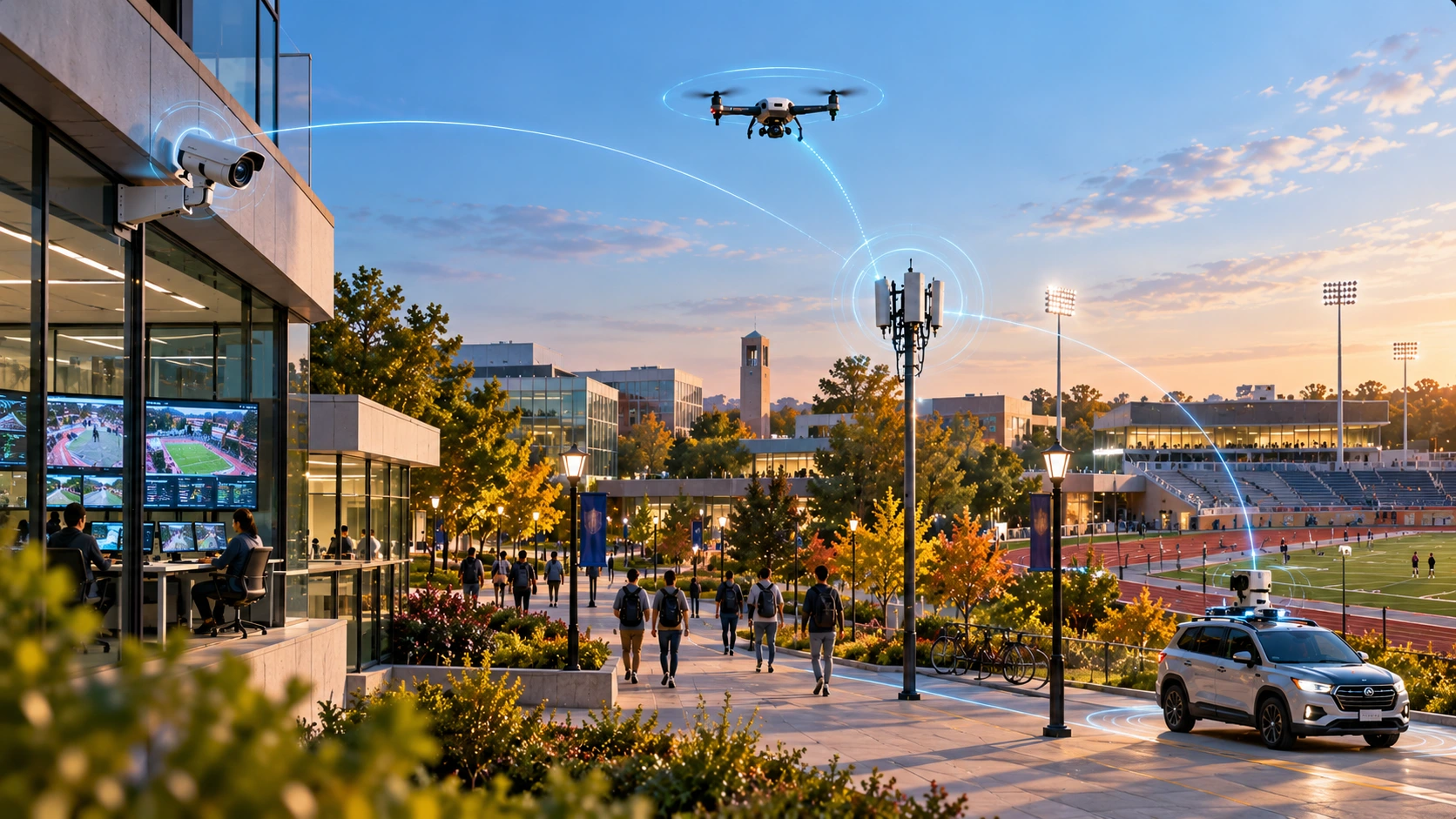
Walk across a modern university campus and you will see a network of cameras, vehicles, drones, production systems and other connected devices. Increasingly, many of them are generating video.
That changes the demands placed on the campus network.
A student streaming a lecture and a security camera are both using wireless connectivity, but they are very different workloads. A patrol vehicle moving across campus, a drone sending HD video from a research field, or a production camera on a stadium sideline has very different requirements for uplink capacity, mobility, latency and coverage.
Wi-Fi remains foundational to the campus. Public cellular remains important for mobility and broad-area connectivity. But some operational workloads need something more predictable: a managed wireless path that can prioritize critical traffic, provide coverage where traditional connectivity is difficult, and process data close to where it is generated.
That is where private 5G/LTE and edge computing come in—not as a replacement for the campus network, but as another layer of it.
Video Is Becoming a Network Workload of Its Own
Campus networks have traditionally been designed around people.
Students, faculty, staff and visitors connect laptops and phones, access applications, stream content and move between buildings. Most of that traffic is relatively flexible: the network needs to provide good performance, but not every connection is mission-critical.
Video-heavy operational workloads are different.
They can generate continuous, uplink-heavy traffic from geographically distributed devices. They can also be mobile. A camera on a parking structure, a body-worn camera on an officer, a drone over a research field and a production camera on a stadium sideline are all generating data at the edge and pushing it into the network.
The question is no longer simply, “Can the network carry video?”
“Can the network deliver the right video, from the right device, with the right priority, latency and security, wherever the workload is operating?”
That is a different networking problem.
Five Representative Campus Scenarios
1. Campus-Wide Surveillance:
Consider a large research university with hundreds of fixed cameras across parking structures, residence hall perimeters and open quads
Some areas may have strong wired or Wi-Fi connectivity. Others can be difficult or expensive to reach with new cabling.
A private cellular layer can extend managed wireless coverage across those outdoor zones. Cameras can be provisioned as Mobile Zones, with traffic policies applied at the device or traffic-class level. A Mobile Edge node can connect directly to the existing video management system, keeping critical video traffic on campus.
The goal is straightforward: consistent feeds, fewer coverage gaps and less competition between security video and general-purpose campus traffic.
2. AI Video Inferencing at the Campus Edge:
Now consider a university using AI-enabled cameras for anomaly detection, perimeter monitoring or other real-time applications.
If every full-resolution stream has to travel to a distant cloud service before an event can be detected, the network is carrying large amounts of video back and forth, and the application is waiting on a round trip that may not be necessary.
With Mobile Edge, AI inference can run on-premises, close to the cameras and the private cellular core.The architecture can process the video locally and send only event clips, metadata or alerts to downstream systems.
The benefit isn’t simply lower bandwidth consumption.
It is a shorter path from camera → network → inference → action.
For applications where timing matters, bringing processing closer to the source can make the network part of the application architecture rather than simply the transport layer.
3. Campus Police:
Campus public safety introduces another challenge: the workload moves.
Patrol vehicles travel between buildings, parking structures, perimeter roads and event zones. Officers may also carry body-worn cameras that need to interact with dispatch and other systems.
Private LTE/5G can extend a managed wireless layer across those patrol routes. In-vehicle video and body-worn devices can be treated as Mobile Zones with defined traffic policies, while the Mobile Edge can provide local connectivity to campus systems.
The point isn’t to replace commercial cellular connectivity everywhere. It is to give the university greater control over the wireless path used by critical campus operations.
For public safety teams, that can mean a more predictable environment for operational video and emergency communications, particularly in areas where coverage, congestion or mobility make connectivity difficult.
4. Game Day: When the Campus Becomes a City
A stadium is one of the best stress tests for campus connectivity.
Highway 9 | Higher Education Tens of thousands of people may arrive with smartphones at the same time that production crews, coaches, ticketing systems, point-of-sale devices and public-safety teams are all competing for connectivity.
Production video might need the highest priority. Ticketing and POS systems have their own operational requirements. Public safety needs to remain isolated from general traffic. Fans still expect their phones to work.
A private cellular architecture can separate these workloads into traffic classes.
For example, eight HD sideline cameras could be provisioned as dedicated Mobile Zones. Ticketing and concession systems could operate under their own policies. Public-safety traffic could be isolated from production and fan traffic. A neutral-host network could provide multi-carrier connectivity across the stadium using shared infrastructure.
The important point is that one physical network does not have to mean one undifferentiated traffic pool.
The network can understand what each workload is—and apply policy accordingly.
And the value extends beyond game day. The same infrastructure can support surveillance, patrol vehicles, emergency communications and other campus operations during the rest of the week.
5. Research Drones and the Connected Research Field:
Research is another environment where mobility, video and edge processing come together.
Consider a drone fleet collecting high-resolution imagery and sensor data across an outdoor research field. Wi-Fi coverage may be inconsistent across the area, while commercial cellular connectivity can introduce variable performance.
Private cellular can provide a dedicated connectivity layer across the research zone. Mobile Edge can then handle selected AI workloads closer to the aircraft and the research systems receiving the data.
That creates a more controlled path for video, sensor data and AI workloads without depending entirely on campus Wi-Fi or routing every workload through the public internet.
One Network Layer. Multiple Campus Workloads.
The value of this architecture is that these use cases don’t necessarily require a different network for every application.
They can run on the same private mobile infrastructure, with policy determining how each workload is handled.
- Mobile Network: 5G/LTE radios can be deployed across parking structures, residence hall perimeters, open quads, stadium fields and research areas. Coverage and capacity can be planned around the campus footprint and the workloads that need connectivity.
- Mobile Edge: An on-premises edge node can run the virtualized 5G core, enforce QoS policies and execute selected AI inference workloads locally. That keeps latency-sensitive processing close to the devices generating the data and can reduce the need to send raw video off campus for processing.
- Mobile Center: IT teams can manage radios, SIMs, AI services, traffic policies and network health through a centralized cloud control plane. Integration with identity, NAC, MDM/eSIM and existing IT workflows can help simplify operations as the number of connected devices grows.
- Mobile Zones: Cameras, patrol vehicles, body-worn devices, drones, production equipment, ticketing systems and POS devices can each be treated as defined workloads with their own security, QoS and traffic policies.
That distinction matters.
A surveillance camera does not have the same network requirements as a food vendor’s payment terminal. A production camera does not have the same priority as a fan’s smartphone.
The network should be able to reflect those differences.
The Point Isn't to Replace Wi-Fi
This isn’t an argument to replace Wi-Fi.
Universities will continue to rely on Wi-Fi for a huge portion of campus connectivity. It is familiar, widely deployed and well suited to many of the applications students, faculty and staff use every day.
The opportunity for private cellular is different.
Some operational workloads need more predictable coverage, mobility, uplink performance, device-level policy or traffic prioritization. These requirements become particularly important when devices are outdoors, moving around campus, generating continuous video or supporting operationally critical applications.
Private 5G/LTE adds another tool to the network team’s toolbox.
In that model, Wi-Fi and private cellular are complementary:
Wi-Fi connects people. Private cellular can provide a controlled wireless layer for machines and operational workloads.
From Connecting People to Connecting Machines
There is a bigger shift underneath all of this.
For years, the campus network was primarily thought of as the infrastructure that connected people to applications.
Increasingly, it is becoming the infrastructure that connects machines to machines—and machines to intelligence.
A surveillance camera generates data. The network transports it. An edge platform processes it. An AI model interprets it. A security system acts on the result.
The same pattern appears with patrol vehicles, drones, production cameras and other connected devices.
That makes the network more than a transport layer.
It becomes part of the operational infrastructure of the university.
And that is why video matters so much.
Video is often the workload that makes the limitations of a traditional connectivity model visible first. It generates large amounts of data, it increasingly involves AI, and many of the devices generating it are mobile or located where traditional wired infrastructure is difficult to extend.
Building a Campus Network Ready for Video
The campus video challenge isn’t simply about adding more bandwidth.
It is about building a network architecture that understands the workload.
Highway 9 Mobile Cloud brings private 5G/LTE, Mobile Edge and cloud-based network operations together in one architecture. It can integrate with existing campus IT systems and provide a managed wireless layer for surveillance, public safety, research, event production and other video-heavy workloads.
The result is a campus network designed not just for more connected people, but for more connected machines—and for the intelligence increasingly running at the edge.
Frequently Asked Questions
What is Highway 9 Mobile Cloud?
Why would a campus use private cellular alongside Wi-Fi?
Where does AI video inferencing happen?
With Mobile Edge, selected AI workloads can run on-premises, close to the cameras and other devices generating data. This can reduce round trips to external cloud services and allow only relevant alerts, metadata or clips to be forwarded when appropriate.
Does Highway 9 integrate with existing campus IT systems?
What spectrum options are available?
What campus use cases beyond video can the network support?
The same architecture can support emergency communications, E911-related workflows, neutral-host connectivity, access control, ticketing, point-of-sale systems, VIP connectivity, connected vehicles, sensors and other machine-to-machine workloads.