
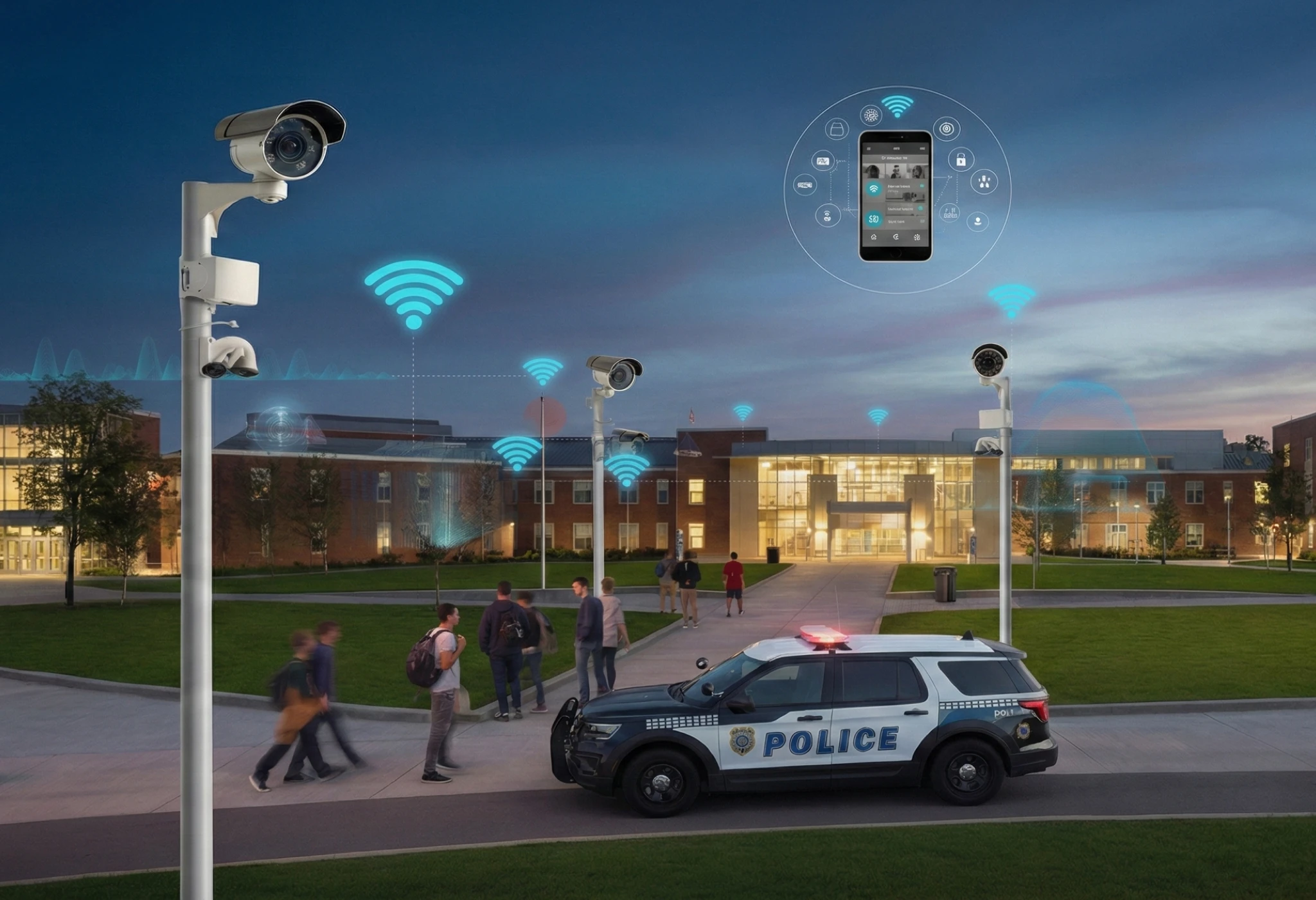
Campus safety failures rarely stem from a lack of cameras or alert systems. More often, post-incident reviews reveal a quieter culprit: dropped connections, delayed video feeds, or responders losing network access at critical moments.
Leaders in higher education are increasingly using advanced data-intensive technology for campus safety operations. From real-time video surveillance and automated license plate readers (ALPR) to instant emergency alerts, the demand for data-intensive apps is rising. However, these innovations are only as effective as the network that supports them.
Legacy infrastructure, particularly Wi-Fi, often struggles to support the mobility and bandwidth requirements of modern security operations. This blog explores why private 5G and Mobile Cloud are emerging as the superior architectural choice for enabling reliable, campus-wide safety infrastructure.
The Wireless Challenge on Higher-Ed Campuses
Limitations of Wi-Fi for Critical Safety
- Inconsistent Coverage: Wi-Fi signals degrade quickly outdoors and struggle to penetrate older buildings or cover sprawling green spaces where emergency poles and cameras are located.
- Congestion: During major events or emergencies, public networks and Wi-Fi often become saturated. When students and faculty flood the network, bandwidth for security cameras and emergency communications drops, creating dangerous blind spots.
- Handover Latency: Security vehicles moving across campus experience connection drops as devices struggle to hand over between Wi-Fi access points.
Public Cellular Trade-offs
Relying on public cellular networks (LTE/5G) surrenders control to commercial carriers. Universities cannot guarantee priority for their safety traffic, nor can they ensure coverage in every basement or service tunnel. Furthermore, routing sensitive video feeds through a public carrier network raises data privacy and security concerns that many CIOs find unacceptable.
Why Mobile Cloud + Private 5G Is a Better Model for Campus Security
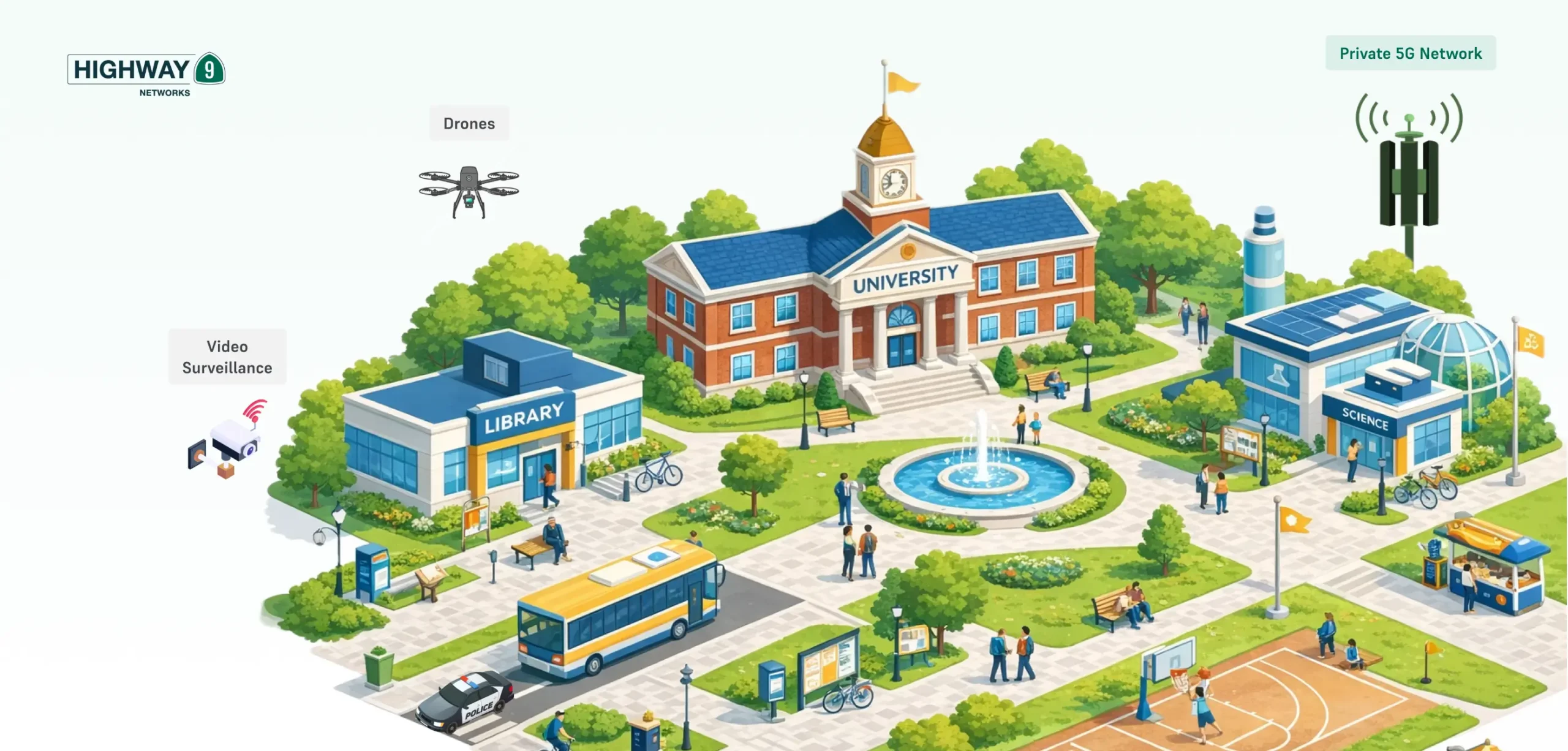
To address these gaps, forward-thinking institutions are deploying dedicated private 5G networks. Unlike public cellular, a private 5G campus network is owned and operated by the university. It offers the reliability of Ethernet with the flexibility of wireless.
Highway 9 Networks introduces a mobile cloud architecture that combines private 5G with edge computing. This model provides three distinct advantages:
- Centralized Control: IT teams gain granular visibility and control over network traffic. Security devices can be prioritized over student streaming services to ensure always-on availability.
- Edge Processing: By processing video and analytics data at the campus edge—rather than sending it to the cloud—latency is virtually eliminated. This is critical for AI-driven analytics that detect unauthorized access in real-time.
- Secure, Isolated Connectivity: Security data remains on-premises. Private 5G uses SIM-based authentication (physical or eSIM), which is significantly more secure than password-based Wi-Fi access.
Core Campus Security & Safety Use Case
Reliable Communications for Campus Security & Emergency Services
First responders and campus police require dedicated channels that won’t fail during a crisis. A private 5G network enables “priority and preemption,” meaning emergency voice and data traffic automatically takes precedence over all other network activity. This ensures that command centers maintain contact with officers in the field, even when the public network is jammed.
Deployment of Surveillance & Safety Infrastructure
High-Definition Video from Campus Police Vehicles
Crisis Communication & Emergency Alerts
Axis Cameras + Private 5G: A Powerful Combination
Axis Communications is a leader in network video, and their devices are ubiquitous in higher education. Combining Axis cameras with private 5G infrastructure unlocks new capabilities for campus surveillance Axis cameras.
Reliable HD and 4K Video Transmission
Secure, Isolated Wireless Backhaul
Edge Compute for Analytics
Modern Axis cameras run advanced analytics at the edge. Private 5G video surveillance networks support this by providing the low-latency connection required to sync metadata with central video management systems (VMS). This integration allows security teams to utilize AI for crowd counting, loitering detection, or license plate recognition effectively.
How Highway 9 Enables Campus-Wide Security at Scale
Mobile Cloud Architecture
Rapid Deployment
Integration with Existing IT
Real-World Impact: University Case Studies
Discover how leading universities achieve unbreakable campus connectivity with Highway 9 — explore our higher education success stories now
The Business Case for Higher Education Leaders
- Improved Safety Outcomes: Faster response times and reliable video feeds directly correlate to improved safety for students and staff.
- Reduced Operational Complexity: Consolidating disparate networks (LMR, Wi-Fi, public cellular) into a single private 5G backbone simplifies management.
- Predictable Performance and Costs: Private 5G eliminates data overage charges associated with public carriers and reduces the need for expensive fiber trenching.
- Future-Ready Infrastructure: The same network that supports HD video surveillance campus today will support autonomous shuttles, delivery robots, and AR/VR learning applications tomorrow.
Building Safer, Smarter Campuses
The mandate for campus safety requires infrastructure that is as resilient as it is advanced. Relying on consumer-grade Wi-Fi or public cellular networks for mission-critical security leaves universities vulnerable to coverage gaps and congestion.
A mobile cloud approach with private 5G campus security enables higher education institutions to take control of their environment. It provides the dedicated bandwidth, coverage, and security necessary to protect the campus community effectively. Highway 9 Networks offers the platform to modernize security infrastructure today while laying the foundation for the smart campus of the future.
Ready to eliminate dead zones on your campus?
Don’t wait for an emergency to test your network limits.
Schedule a Mobile Cloud Demo or Download the Higher Ed Solutions Brief to see how Highway 9 can modernize your safety infrastructure in days, not months.